آزمیران
دستگاهای آزمایشگاهی
مواد شیمیایی
شیشه آلات
محیط کشتهای میکروبی
فیلتر یا کاغذ صافی
ملزومات
سکوبندی
مقالات و توضیحات
کاتالوگ ها
جستجوهای مرتبط
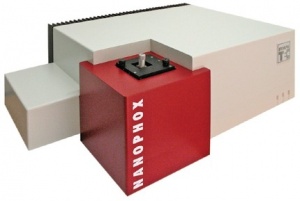
NANOPHOX: Particle Size and Stability Analysis of Opaque Suspensions and Emulsions
With Photon Cross-correlation Spectroscopy Sympatec's NANOPHOX applies a
new technique allowing for the simultaneous measurement of particle
size and stability of opaque suspension or emulsions of nanoparticles in
the size range of about 1 nm to some 10 µm. Photon Cross-correlation
Spectroscopy (PCCS) is a powerful advancement to the established Photon
Correlation Spectroscopy (PCS), which is limited to highly diluted
samples. The key principle of PCCS is a 3D cross-correlation technique.
In a special scattering geometry, the cross-correlation of the scattered
light allows for reliable separation of single and multiple scattered
fractions.
PCCS has several advantages:
- With PCCS the multiple scattering is completely eliminated. Thus, PCCS extends the evaluation method of PCS to opaque suspensions and emulsions of high concentrations.
- Higher particle concentrations lead to higher count rates and shorter measuring times.
- In addition, the amplitude of the cross-correlation function represents the amount of single scattered light. This extremely sensitive information is used for the analysis of sample stability.
- As multiple scattering is eliminated, the results are usually independent of concentration. Now, changes with increasing concentration can be investigated directly with a dilution series as any contribution of multiple scattering is avoided. If concentration is too high only multiple scattered light remains and the system automatically indicates the application boundaries.
- The results are independent of the measuring volume position within the sample vial. The measuring volume position can be varied in order to optimise count rates and realise shortest measuring times.
- High particle concentrations reduce the sensitivity of this method to pollutions. Standard liquids in a regular laboratory environment can be used.
- The PCCS set-up can be simply switched into the PCS mode, using one detector only calculating the auto-correlation function. Other PCS-based measurements can now be compared directly to the NANOPHOX results in PCS mode.
NANOPHOX
This innovative instrument is
appropriate to scientific and technical as well as industrial use.
Housed in a compact body this table top instrument contains light
source, detectors, the correlator, and the tempered water basin holding
the sample vial. Ready for standard measurements in your laboratory.
For further information please visit our product website or request information now!
محصولات مرتبط
:
۱۱۱,۰۰۰,۰۰۲تومان




۷۹۹,۲۰۰,۱۲۴تومان
۱۱۷,۶۶۰,۱۲۴تومان
۲۱۹,۷۸۰,۱۲۴تومان